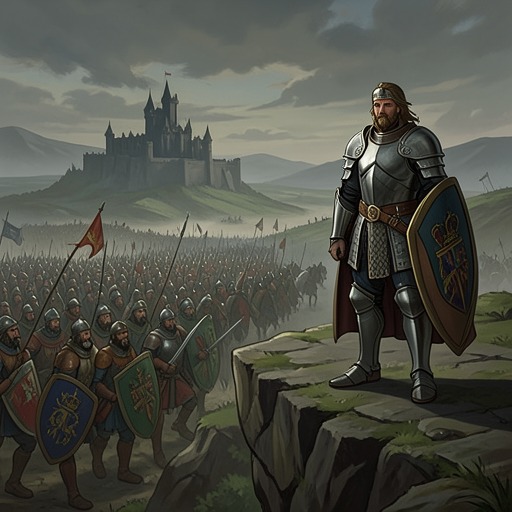
King Henry V
Henry VKing Henry V is presented as both claimant and commander, a ruler whose decisions move from the interpretation of inheritance law to the consequences of battle. His insistence on right and conscience gives the French claim a formal test; the threatened destruction of Harfleur, the order to kill prisoners, and the warning that a king must answer for a bad cause expose the moral weight that legal argument cannot settle.
Claim and Conscience
At court, King Henry V asks the Archbishop of Canterbury to explain whether Salic Law should bar his claim to France. Canterbury answers that the law is the only stated obstacle to the claim, then contests its application: the Salic land, he argues, lies in Germany between the Sala and the Elbe, rather than in France. He further identifies that territory with Meisen and invokes the reported settlement of the French beyond the Sala in 805. The legal case thus turns on where the law originated and to which realm it applies, not simply on the wording of the rule.
The king does not treat the argument as a merely technical victory. He asks Canterbury whether he can press the claim with right and conscience, and warns the prelate to take care before the king’s war is awakened. His warning invokes the blood that two contending kingdoms may shed and places responsibility on those who counsel him as well as on the ruler who acts. In this exchange, the authority to make war is presented as a religious and political burden, not just a prize of inheritance.
War and Its Moral Costs
At Harfleur, King Henry V threatens that if the city remains only partly won, mercy will be shut out and his soldiers will have freedom to act with bloody force. The warning makes the siege a test of what his claim means for people exposed to it: the language of lawful inheritance now stands beside the prospect of violence against a city. His authority is expressed not only through argument but through the threat of what his army may do.
The cost of that authority is challenged directly by Michael Williams. Williams argues that if the cause is not just, the king himself will face a heavy reckoning when the bodies of those killed in battle are accounted for. His objection shifts the question from whether the claim can be argued to whether the deaths caused in its pursuit can be morally borne. It also echoes the king’s earlier concern about bloodshed, but turns that concern into an accusation of personal responsibility.
Command at Agincourt
During the battle, news that the French have reinforced their scattered forces prompts King Henry V to order his soldiers to kill their prisoners. A report that the king’s tent has been burned and everything in it carried away is offered as a further explanation for the order. The sequence presents a commander making an immediate decision under renewed threat, while the reported attack on his tent supplies a retaliatory rationale; neither detail removes the moral force of Williams’s earlier warning about the king’s responsibility for the dead.
In a separate exchange over the number of Englishmen available, King Henry V asks who wishes for more men and names the Earl of Westmoreland. The moment places the king’s judgment of the army’s numbers in conversation with his nobles’ concerns. Its significance here is the contrast between a ruler who must decide how to prosecute the campaign and the people around him who voice what they believe the army needs.
Terms of Peace
At a later royal meeting in France, King Henry V opens by identifying peace as the purpose of the gathering. The King of France says that he has consented to all reasonable terms, and King Henry V turns to the English lords to confirm that consent. The meeting brings the claim, previously argued through law and pursued through war, into the language of negotiated agreement. The available exchange establishes the acceptance of terms, while leaving their particulars unstated.